
Let the roots breathe.
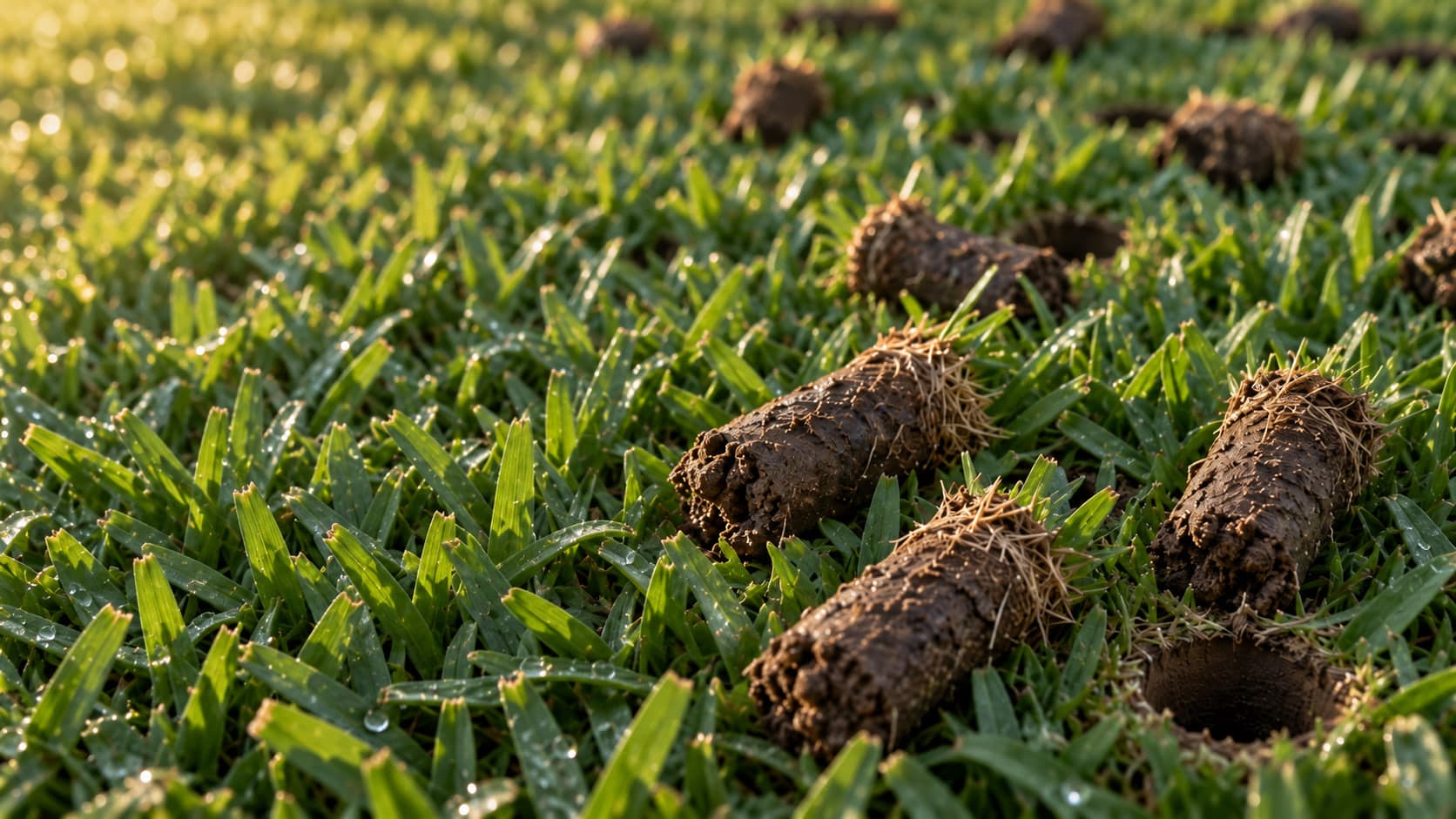
Core aeration pulls finger-thick plugs out of compacted Houston clay so air, water and fertilizer can reach the roots.
Why Houston lawns need it
Much of the Houston area sits on dense, black clay that packs down hard and cracks when it dries. Compacted soil sheds water and starves roots of air.
Aeration opens thousands of small holes. The grass grows into them while it’s actively growing.
What we pull
- Cores up to ¾ inch wide, from holes 2 to 3 inches deep
- Holes roughly 2 to 3 inches apart
- Cores left on the lawn to break down
After we aerate
- Water if the weather turns dry: an aerated lawn dries out faster
- Let the cores dry for a couple of days, then mow as usual to break them up
- If they bother you, rake them into the grass
Facts: Clemson Cooperative Extension; LSU AgCenter; University of Illinois Extension; USDA soil survey (Lake Charles series).
Common questions
How much does aeration cost?
It’s priced by the size of your lawn, and your quote gives the exact price. Prepay online for the season and you save 15% when your order includes aeration.
Is aeration part of the 8-Step Program?
No, it’s an add-on. We can aerate at your spring or fall 8-Step visit, or come out just to aerate.
When do you aerate?
In spring, April and May, and in fall, October and November, while the grass is actively growing. How often a lawn needs it depends on its soil and how much traffic it gets.
What’s the difference between core and spike aeration?
A core aerator’s hollow tines pull plugs of soil out of the ground. Spikes only push the soil aside, which does nothing for compaction, and spiking to the same depth year after year can pack a hard layer that makes it worse. We only core aerate.
Should I aerate or dethatch?
It depends on the problem. Aeration relieves compacted soil. Thatch becomes a problem once it is about half an inch to an inch deep, when it starts to hold back water and can harbor insects and disease. Texas A&M AgriLife lists hollow-tine aeration as one way to remove it, along with a vertical mower or power rake, and thatch builds up faster on compacted and heavy clay soils, so aerating helps on both counts. We offer core aeration, not dethatching.
What do I need to do before you aerate?
Mark your sprinkler heads, shallow irrigation lines, invisible pet-fence wires and any buried cables. We can’t be responsible for damage to anything that wasn’t marked.
Do I need to be home?
No. We’ll text or email you about a day before we come. Please leave gates unlocked and keep pets inside that day.
What if it rains?
Aeration works best in moderately moist soil. Soaked ground is messy to aerate and packs down further, so if rain would make it ineffective, we reschedule at no cost to you.
Pick spring, fall or both.
One visit for each season you choose.
- No contracts
- Licensed & insured